Every entry on DA Form 7595-5-8 exists because a record system needs it in writing. The form's official title is Perform Spinal Immobilization: Long Spine Board, and it is raised whenever an office must apply a long spine board in a way that survives the departure of everyone involved. Memory does not transfer between assignments; a filed document does. The edition dated March 2014, status not stated, is what stands here, spread across 1 page(s) and about 148 fields — a count that reflects how much detail the receiving system requires, not how much the drafter wishes to give.
Behind any Army form sit two separate decisions. What the document asks is settled by TRADOC, which maintains and revises it. Whether you raise it, and where it goes once signed, is settled by TC 8-800. That division is the reason a form can outlive several changes in the process it serves.
Retrieval governs the order of entry. The head of the form takes name, identification number, unit and date, and those values become the handles by which the record is found later — the substantive blocks are never searched on. This is why the spelling must match official records exactly rather than approximately.
Much of the form's behaviour follows from its being a fixed page. Tab order was set at build time along the reading sequence, which is why tabbing catches boxes a pointer passes over. Exclusive groups release one choice when another is made because a record cannot carry two answers to a single question. Single-line fields refuse to wrap because every entry must print where the layout expects it — text beyond the width is lost at the margin, visible on screen to the end. That is what remarks areas and continuation sheets are for. Marking a field that does not apply matters for a related reason: emptiness is ambiguous, and a reviewer reading the file later cannot distinguish an omission from a decision.
Signing is the act that makes the document evidence, and until it happens the entries are only a proposal. Additional signatures — reviewer, approver, witness — each stand for a separate judgement, dated when applied so the record shows who accepted what and in what order. The common faults all damage that record in the same way: a blank mandatory field breaks the chain of required answers, swapped digits in an identification number detach the document from its subject, an inverted day and month misplaces it in time, and stale data from a reused copy states things nobody meant to state.
Behind the Privacy Act statement is a requirement that anyone asked for personal data be told, in advance, under what authority it is sought, for what purpose, who else routinely sees it, and whether refusal is possible. Reading it after completing the fields defeats its function. And the completed form is itself a personal record from that point on, subject to the handling rules such records carry.
Download the form
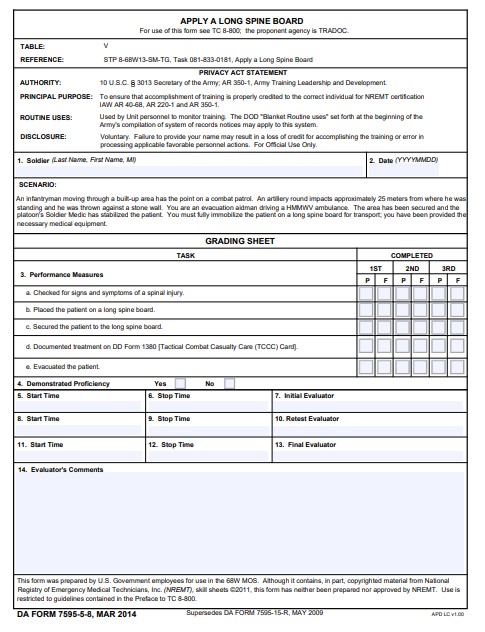
The published formats — PDF, XFDL — reflect the range of places a form gets filled in. Where there is a computer, the fillable pdf supplies live fields that keep entries positioned and readable. Where there is not, the printable pdf gives the identical page as flat artwork for pen entry. The distinction is one of setting rather than of authority; the page is the same document in both.
Software determines whether an entry lasts. A browser viewer is designed for reading, and several will take typed input into fields without any means of writing it back — the text is simply absent when you reopen. A standalone reader handles the form structure properly. The xfdl file is IBM Lotus Forms, carried in Army systems for the routing and signature support it provides, which is why the Lotus Forms Viewer is its only reader.
No charge and no account apply: these are published documents, and access to them is not something a distributor is entitled to price.
What the form asks for
- A_1_F
- A_1_P
- A_2_F
- A_2_P
- A_3_F
- A_3_P
- B_1_F
- B_1_P
- B_2_F
- B_2_P
- B_3_F
- B_3_P
- C_1_F
- C_1_P
- C_2_F
- C_2_P
- C_3_F
- C_3_P
- ContentArea1
- DATE
- D_1_F
- D_1_P
- D_2_F
- D_2_P
Where the signed form goes is settled by TC 8-800 rather than by the office holding it — a named recipient, the unit administrative channel, or the individual's own file, depending on why it was raised. Retention likewise belongs to the records schedule for the series, which exists so documents are kept for as long as anyone might need them and no longer. Keep a copy before release; the original serves the file from then on, not you.
Forms cluster by series and number for the same reason files do: shared proponency and a shared prescribing directive usually mean a shared process. So a document in the DA series referenced on the face of another is generally part of the same transaction, and continuation sheets, cover sheets and transmittals belong to the package from the outset rather than arriving after a query.
Editions change because the process changes, and the printed edition date is the only marker of which version a page belongs to. A copy saved locally cannot know it has been superseded, so the date on it is compared against the edition in force before reuse. Records already executed under an earlier edition are left alone — a document is read under the terms it was made, and reopening completed files to match a later form would falsify the account.
A word on where this page sits. These are reproductions of published Department of the Army documents, made available by an independent site with no official role and no authority to issue forms. The structure described above — proponent, prescribing directive, records schedule — exists apart from this site entirely, which is why nothing written here is legal advice and why acceptance by any office is not something that can be promised. Put questions of entry, requirement or eligibility to TRADOC or to the administrative office servicing your unit.
Questions and answers
- What is DA Form 7595-5-8?
- Perform Spinal Immobilization: Long Spine Board
- Which edition is current?
- March 2014
- Who is responsible for this form?
- TRADOC
- In which formats can it be downloaded?
- PDF, XFDL